A governed operations platform connects the records, roles, approvals and evidence required to run a services business, so work can move across teams and external partners without losing control or context.
Services businesses rarely break because they cannot store a customer, a contractor, an invoice or a timesheet. They struggle when those records need to move together.
A client agreement becomes an assignment. The assignment creates delivery evidence. Approved work affects billing. A vendor invoice needs to be compared with the commercial and delivery context behind it. A payment decision needs an owner, an approval boundary and a history. Each step may look simple on its own. The difficulty sits in the handoff.
A governed operations platform is designed around those handoffs. It keeps the operating record connected while controlling who can see it, who can act on it, which organisation or entity owns it, what needs approval and what evidence remains afterward.
Why services operations become fragmented
A services company can assemble capable tools for recruiting, HR, project delivery, time, accounting and vendor management. Every tool may do its own job well. The operating problem appears when one team needs context from another.
Finance needs to know whether the work behind an invoice was approved. Delivery needs to understand the assignment and commercial period behind a timesheet. A vendor needs payment context without gaining access to internal finance. Leadership needs to see operational pressure before it becomes a month-end reconciliation exercise.
When those relationships live in spreadsheets, email threads or people’s memory, the business starts paying a coordination tax:
- the same client, person or engagement is entered differently in several places;
- approvals happen in messages without remaining attached to the record;
- external parties receive screenshots and status updates instead of a controlled workspace;
- reports explain what happened, but not who should act next;
- reconciliation becomes detective work because the commercial, delivery and finance evidence is separated.
The answer is not necessarily one enormous application that performs every specialist function. The answer is a governed operating layer that preserves the relationships and control points between them.
What “governed” changes
Connected data is useful. Connected data without boundaries can create a larger problem. Governance determines how operating context becomes usable without becoming uncontrolled.
Who can see the record?
A finance user, delivery manager, contractor and Vendor Admin do not need the same view. Access follows the role and responsibility.
What bounds the work?
Organisation, billing entity, client, assignment, person and vendor context prevent a valid action in one scope becoming an unsafe action in another.
Who can move it forward?
Submission, comparison, approval, rejection and payment are different decisions. The platform keeps those boundaries visible.
What remains afterward?
The decision should retain its source documents, amount and period context, status changes and responsible participants.
These controls are not a compliance layer added after the workflow is designed. They are part of the workflow itself. The same record that makes work faster also explains why an action was available, who took it and what supported the decision.
The connected operating record
The platform’s moat is not a long module list. It is the continuity between records. A person is connected to an organisation and a role. A contract is connected to an entity and a client. An assignment connects that commercial agreement to work. Time or delivery evidence connects the work to billing. A vendor invoice and bill connect external evidence to a finance decision. The history remains attached as the record moves.
That continuity matters because most operational questions cross functional boundaries. “Can we invoice this work?” is not only a finance question. It may depend on the assignment, the approved period, the client terms and the supporting evidence. “Can this vendor be paid?” is not only a payment question. It may depend on the bill, invoice comparison, entity, approval state and payout ownership.
When does a services business need this model?
The signal is not company size alone. It is the number and consequence of the handoffs the business must coordinate.
The same workflow must preserve which organisation contracts, bills, pays or carries responsibility.
Employees, independent contractors, vendor resources and client-facing teams require different records and access boundaries.
Teams repeatedly compare timesheets, invoices, bills, rate cards or payment records because the relationships are not persistent.
Important decisions happen in chat or email, leaving the operational system with a status but not the supporting context.
Contractors and vendors need useful visibility, but the business cannot safely expose its internal operating view.
Leadership can see a lagging number but not the exception, owner or next safe action behind it.
From reporting to operational decisions
A conventional report summarises records after they have accumulated. Operational intelligence should help the right person understand pressure while there is still time to act.
That means showing more than totals. A useful operating view brings together the signal, the underlying records, the responsible role and the available next step. It helps Finance distinguish exposure from action. It helps Delivery see which work is ready, blocked or at risk. It helps an external partner understand what is waiting without exposing internal data.
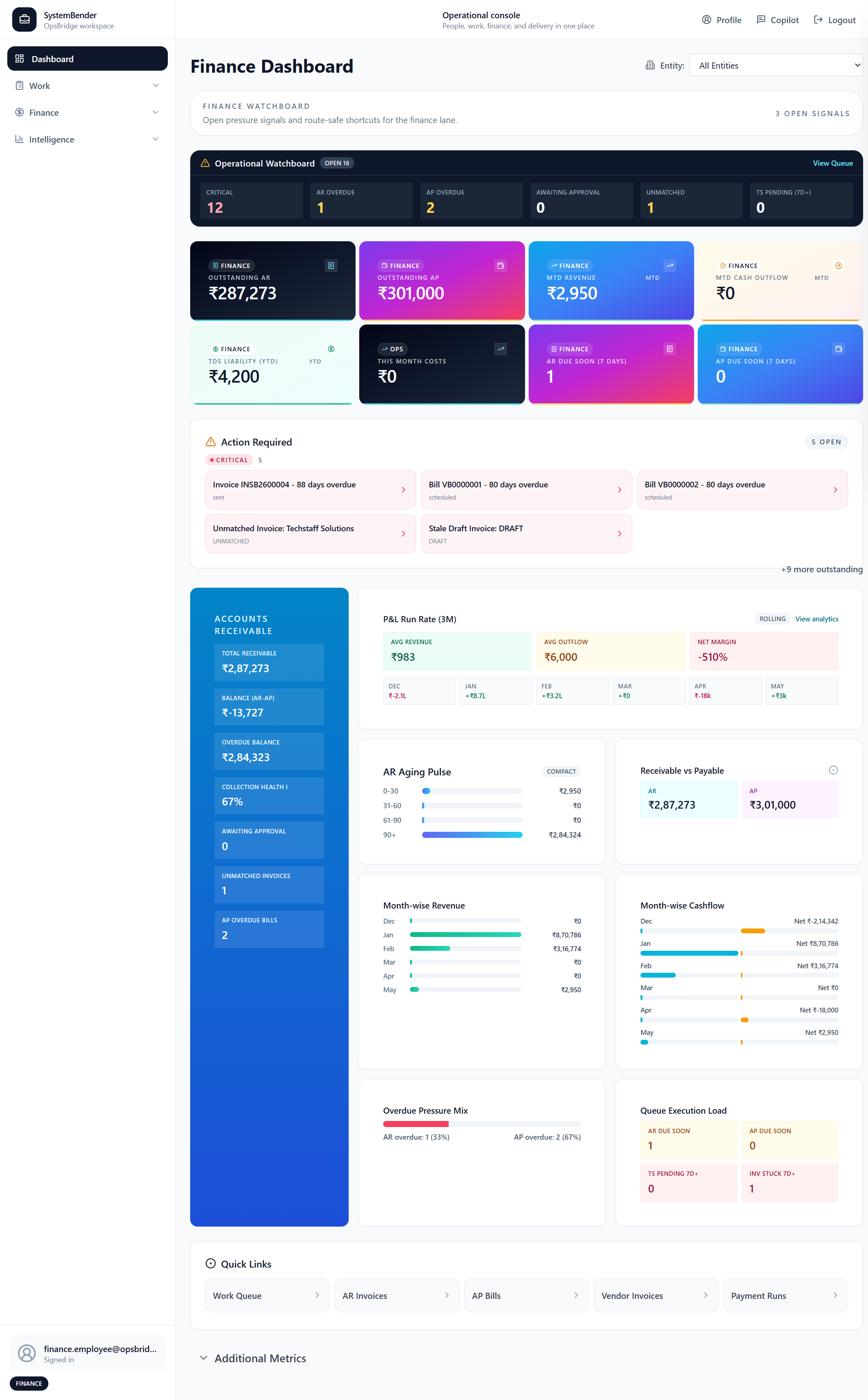
OpsBridge brings operating signals, receivables, payables and trend context into one Finance Dashboard. The public screen uses sample data from the production product.
What governance looks like in practice
Governance becomes visible at the decision surface and at the boundary between internal and external work.
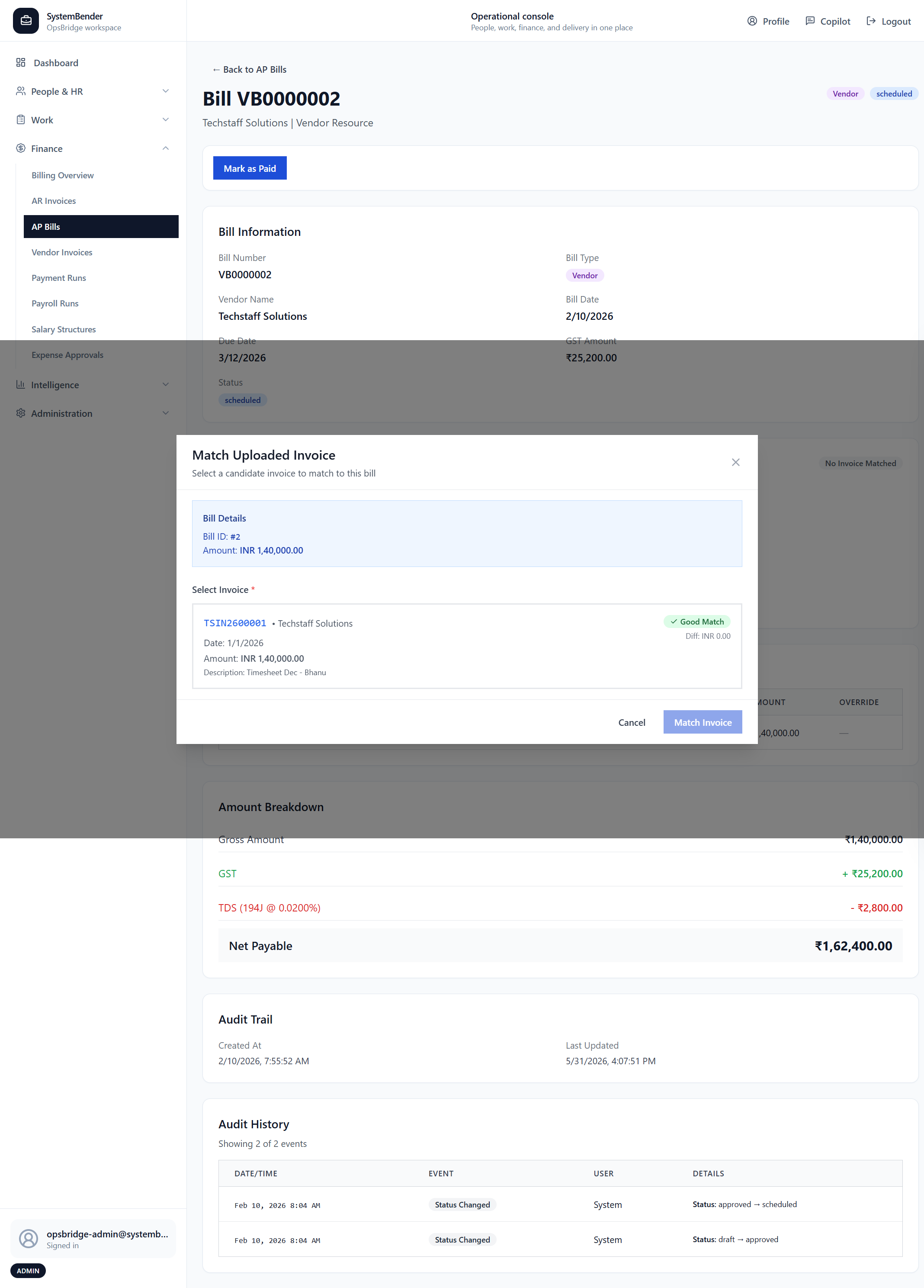
Compare before confirming
The invoice-matching view keeps vendor evidence, bill context, amount variance and decision history together.
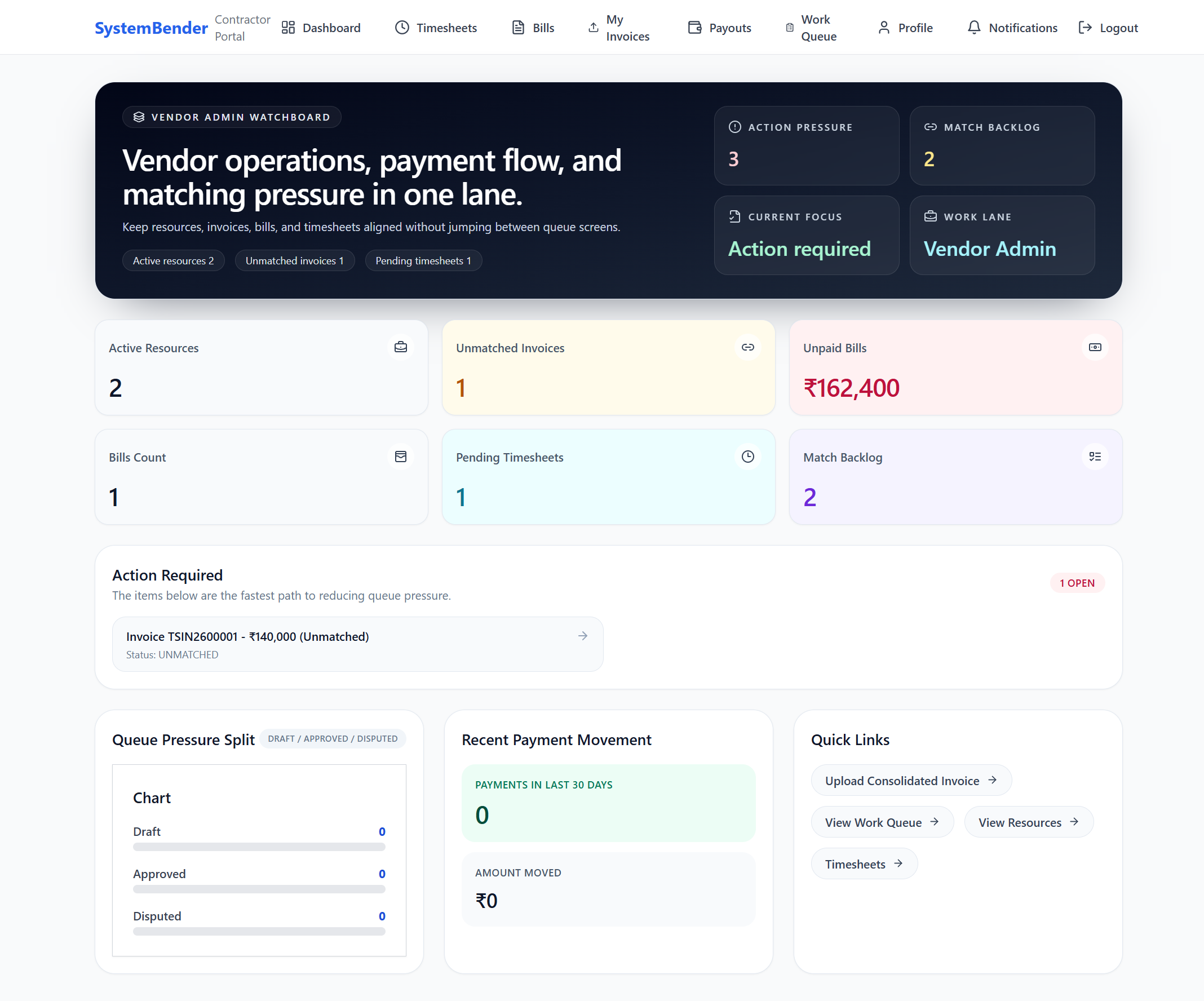
A focused Vendor Admin workspace
Vendors receive their own operational and payment context without entering the internal finance console.
The platform does not remove human judgment from these decisions. It gives that judgment better context, clearer boundaries and a durable history. Automation can then handle repeatable coordination around the decision without pretending that every exception should be resolved by software alone.
How OpsBridge applies the model
OpsBridge is the governed operations platform for services businesses, Live in Production and used by SystemBender in its own India, Singapore and Malaysia operations.
It connects workforce, contracts, assignments, time, billing, payables, payroll, vendors and compliance through role-aware internal and external portals. The aim is not to place every user inside the same interface. It is to give each role the appropriate operating context while keeping the underlying record connected.
This is also why the wider product family matters. OpsBridge Talent is the Roadmap AI Recruiting Engine. JD Reviewer is its Roadmap — Phase 1 freemium entry product. Advisr is the Roadmap Organisational AI Diagnostic and Advisor. The long-term value comes from carrying useful context across the seam between talent decisions and productive, governed work—not from adding disconnected AI features.
Can context survive the handoff?
If a decision requires people to reconstruct the client, contract, assignment, evidence, entity, approver and external status from several systems, the operating record is not connected. A governed operations platform makes those relationships durable, then uses them to support faster work, fewer errors, clearer compliance and better decisions.