SystemBender built OpsBridge after discovering that every client, project and geography could change the operating rules, while separate tools could store parts of the work but could not keep contracts, assignments, time, finance, vendors and approvals in sync.
We did not begin by deciding to build a software product. We began by trying to run a services business responsibly.
At first, the familiar mix of spreadsheets, accounting tools, documents, email threads and message-based approvals was workable. Each tool held something useful. The system depended on the team remembering how those pieces related, which rules applied to each engagement—and on someone noticing when they did not line up.
That approach becomes fragile before it becomes visibly broken. Work still moves. Invoices still go out. People still get answers. But the coordination required to produce those outcomes grows quietly, and the operating history starts to live in people’s memory rather than in the record itself.
The operating problem was not a missing form
We could already record a client, a person, a contract, a timesheet, an invoice and a payment. Adding another form for any one of those things would not solve the problem.
The difficult questions appeared between them. Which legal entity owned the contract? Which assignment and commercial period did the work belong to? Had the relevant evidence been approved? Which vendor, worker or client-facing participant needed an external view? Who was allowed to see the rate, the bill or the payout context?
The front of the operation was different for almost every engagement. Clients wanted customised workflows. Working days could vary by project. Holiday calendars changed by geography and sometimes by the client. Payment terms did not always align between the client agreement and the partner, vendor, resource or contractor obligations behind it. Timesheet cut-offs, approvers and correction paths also varied.
The working pattern and billable calendar could differ from one project or engagement to another.
Local, client and project calendars affected availability, time capture, cut-offs and expected delivery days.
Client receivable terms and downstream partner or contractor obligations did not necessarily move on the same timetable.
Submission frequency, cut-off, approver and correction paths needed the right engagement context.
None of those variables was unusual on its own. The difficulty was keeping the correct combination attached to the right client, project, person and entity from setup through delivery and finance.
The work was stored. The operating context between each piece was not.
The reason OpsBridge existsThat distinction changed the product we needed to build. The goal was no longer to digitise a collection of activities. It was to keep context and accountability intact as the work moved.
Separate tools stored data, not the handoff
A services-business workflow rarely belongs to one department. A commercial agreement becomes an assignment. An assignment creates delivery or time evidence. Approved work affects billing. A vendor invoice or contractor payment needs to be understood against the work and terms behind it.
When those stages live in different systems, the joins become manual. A filename, message or spreadsheet row has to stand in for the relationship. The more operating entities, workforce models and external participants involved, the more important those joins become.
No one could keep the whole operation in sync.
A front-end change could be missed by the people managing partners, vendors, employees, vendor resources or contractors at the back. The consequences were operational, financial and visible to the people waiting for an answer.
We learned that integration alone was not enough. Moving a value from one application to another does not explain who owns it, who can act, what changed, what evidence supports the decision or whether the same action is valid in another organisational scope.
Encoding the workflow exposed hidden decisions
Internal operations often look simpler than they are because experienced people resolve ambiguity without naming it. Building software removes that hiding place.
Every workflow forced us to make a decision explicit:
Which organisation owns the work?
A client, contract, assignment, bill and payment need the correct entity and operating scope, not just a shared company label.
Who needs which part of the record?
Finance, delivery, contractors and Vendor Admins need different views without losing the shared context underneath them.
What decision moves it forward?
Submission, review, comparison, approval and payment are distinct actions with different responsibilities.
What should remain afterward?
The source documents, amounts, periods, status changes and participants should stay attached to the operating history.
These were not configuration details. They were the product. Once those decisions became explicit, it was possible to make the workflow faster without making responsibility less clear.
Access, scope and approval were product problems
Access control was one of the earliest reminders that an internal tool still needs serious product thinking. “Internal” does not mean every user should see every record, rate, invoice, payroll detail or vendor relationship.
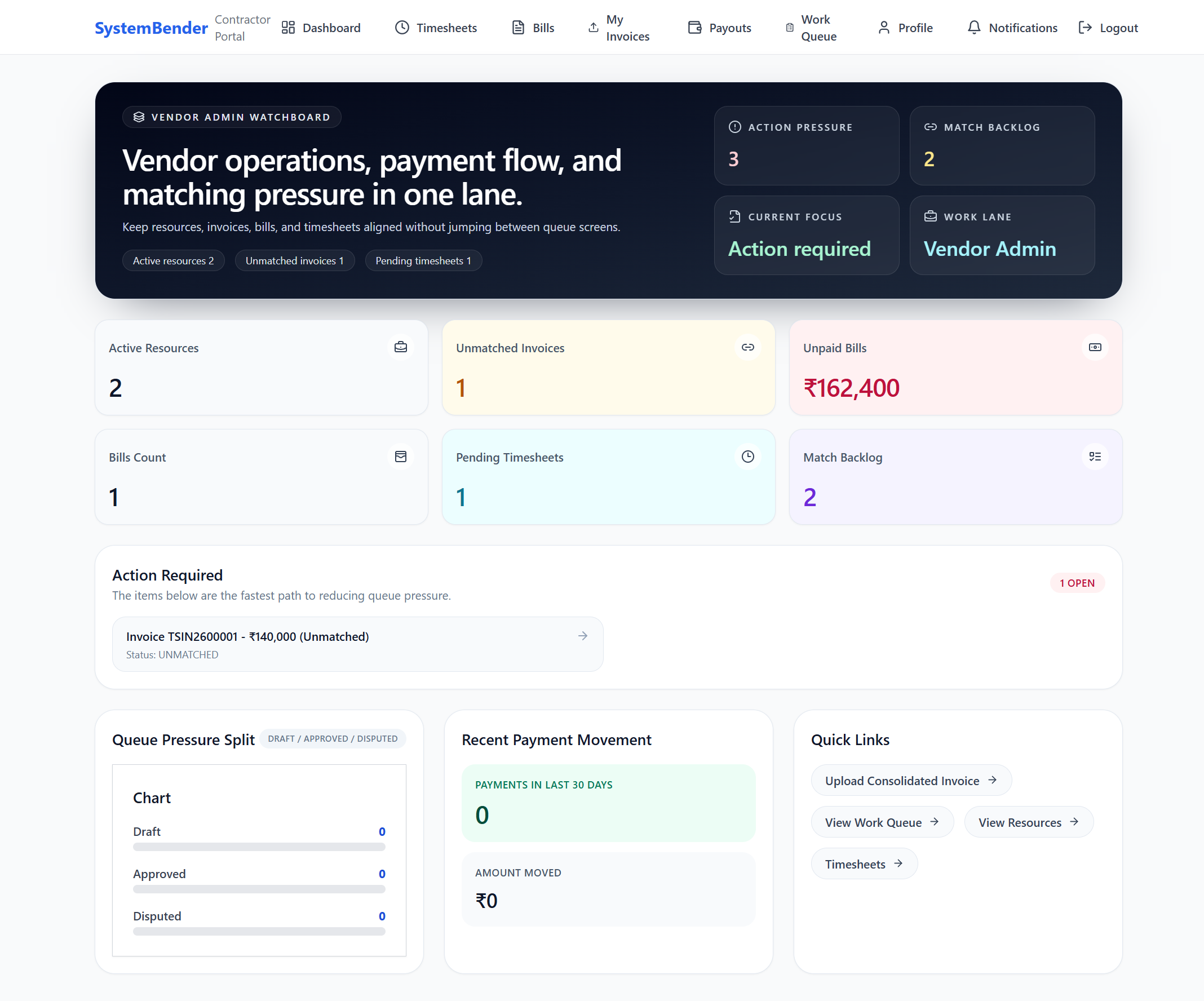
The correct boundary depends on role and context. A delivery manager may need assignment status without payroll access. A contractor needs their own work and payment context without seeing another contractor. A Vendor Admin needs a focused workspace, not a restricted version of the internal finance console.
Approval design created a similar lesson. A flexible workflow that can represent anything can become harder to understand than a clear workflow shaped around the actual decision. We found ourselves asking which paths were genuinely different and which were historical habits that software should not preserve.
Governance therefore became part of the interaction design: what appears, what action is available, which scope it applies to, what must be reviewed and what history remains.
The system became useful when the record stayed connected
The turning point was not a longer feature list. It was the ability to follow the same operating story across roles and stages without reconstructing it each time.
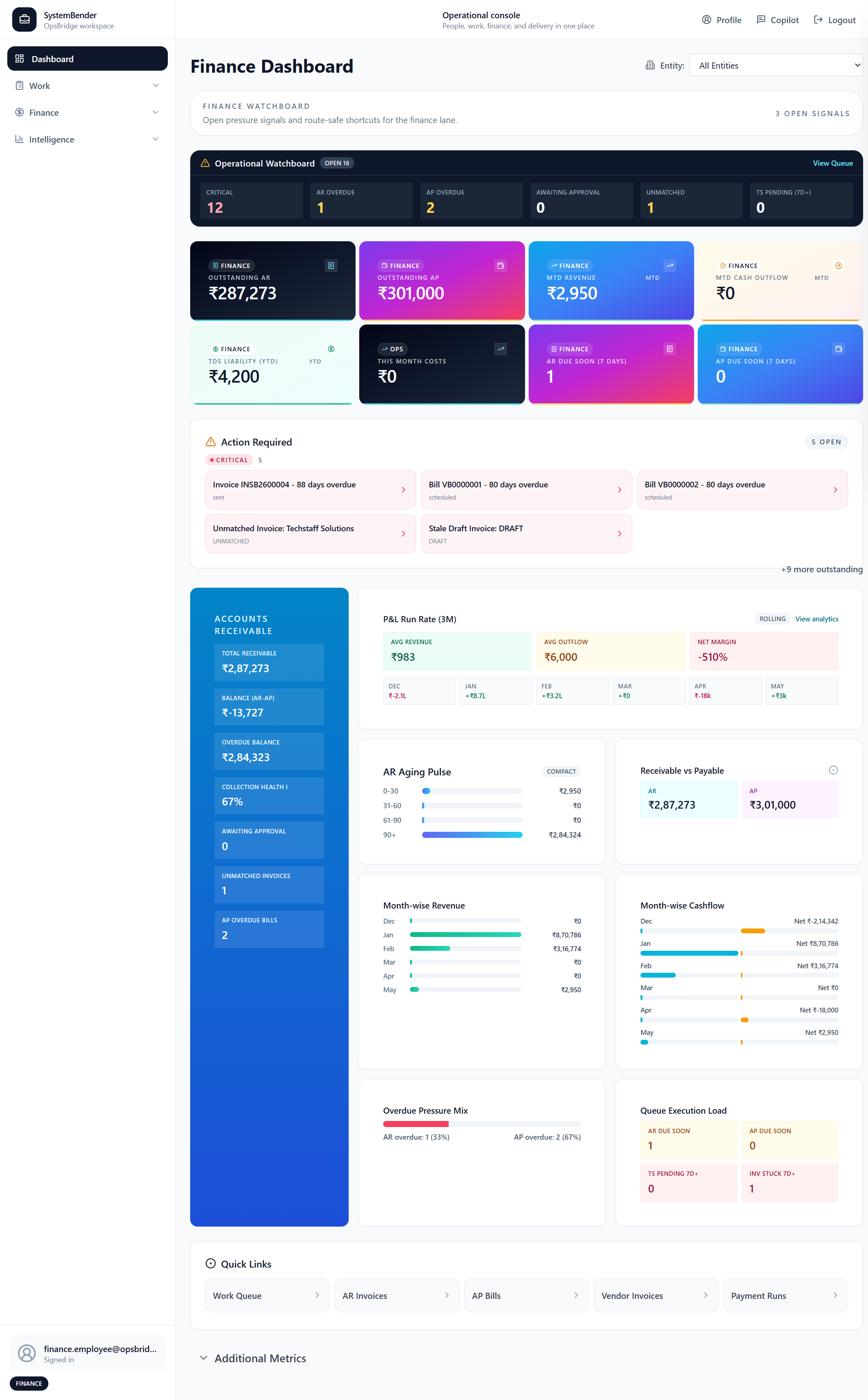
A leadership or finance view could show a current signal because the underlying client, entity, assignment, billing and payable context remained connected. The dashboard was no longer a separate reporting exercise; it became a lens on the same governed record used to do the work.
The Finance Dashboard leads with operating signals, receivables, payables and trend context drawn from the connected product record.
What building for ourselves changed
Using OpsBridge inside SystemBender changed how we judged the product. A workflow could be technically correct and still fail the operating test if it required people to remember too much, switch context unnecessarily or search for the evidence behind the decision.
Context should not disappear when work crosses from commercial terms to delivery, finance or an external participant.
Real operations include missing evidence, amount variance, rejection, reassignment and delayed decisions. The product must make those states understandable.
A partner workspace should reveal the right context directly rather than expose an internal console with most of it hidden.
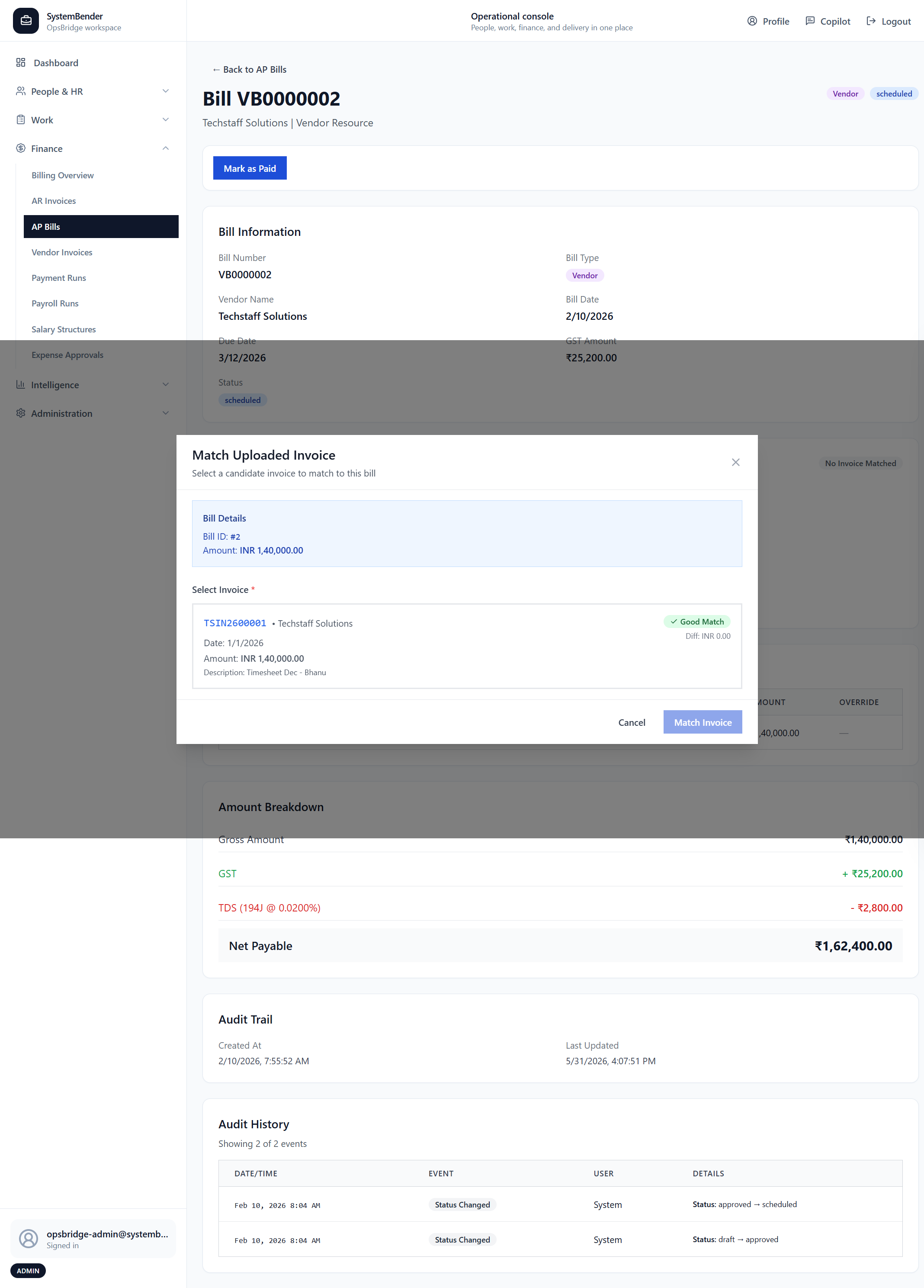
Review becomes faster and more defensible when the source document, comparison and history remain attached to the work.
Compare before confirming
The invoice-matching view keeps vendor evidence, governed bill context, amount variance and decision history together.
A focused Vendor Admin view
Vendors receive their own resource, billing and payout context without entering the internal finance console.
Why OpsBridge is now a product family
OpsBridge is Live in Production as the governed operations platform for services businesses, and SystemBender uses it across its India, Singapore and Malaysia operations.
Building it also made the next boundary visible. Recruiting and talent decisions lose value when their context stops at the point of hire. The useful record continues through onboarding, assignment, delivery, renewal and redeployment. That handoff is the Seam between OpsBridge Talent and OpsBridge.
OpsBridge
The governed operations platform for services businesses. It connects workforce, contracts, assignments, time, finance, vendors, approvals and evidence.
OpsBridge Talent
The AI Recruiting Engine, carrying useful hiring context toward productive work through the Seam.
Advisr and JD Reviewer
Advisr is the Organisational AI Diagnostic and Advisor. JD Reviewer is the Roadmap — Phase 1 freemium entry product under OpsBridge Talent.
The common principle is not AI for its own sake. It is better context at the point of decision, with automation introduced where it can improve speed, accuracy and coordination without hiding responsibility.
The next action is only as good as the record behind it.
If someone must reconstruct the client, entity, contract, assignment, evidence, approval and external status before acting, the operating system has lost the story. OpsBridge was built to keep that story connected—then make the next decision clearer.