Invoice matching breaks when a bill is compared with another document but not with the governed operating context behind it: the correct assignment, working calendar, approved time, rate, currency, commercial period, legal entity and payment terms.
The invoice usually arrives last. The obligation behind it began much earlier.
A client agreed to a commercial model. A person was assigned under specific terms. Work took place within a project and geography. A timesheet or other delivery evidence was submitted and approved. A vendor or contractor then raised a bill, and someone had to decide whether that bill should become a payable.
If each stage is held separately, matching starts too late. Finance sees the final document but has to reconstruct the operating story through files, spreadsheets, messages and people’s memory.
The staffing payment problem crosses markets
Late payment is often discussed as a collections issue. For a staffing or contractor business, the operating model creates a sharper exposure: worker and contractor obligations, client approvals and invoice collection run on different clocks. The precise legal and commercial rules vary by country, but the operating challenge repeats across markets.
The exact obligation is jurisdiction-specific, but the separation between work, approval and collection is real. As one concrete UK example—not a rule for APAC markets—an employment business must pay a temporary work-seeker for hours worked even if the hirer has not paid the agency or authorised the timesheet. Elsewhere, contracts and local labour rules differ, but staffing firms still need a reliable evidence chain for time, approval, billing and payout.
Jurisdictional example: UK Government guidance for employment agencies and employment businesses.
The cascade is easy to recognise. A timesheet is late. Approval misses the cut-off. The client invoice is delayed or queried. The vendor bill arrives against a period that has not been closed. The staffing firm still has a payroll or contractor obligation, while finance teams chase the context needed to bill and reconcile. Upstream uncertainty becomes downstream financing pressure.
The invoice is the end of an obligation chain
A useful match must follow the obligation from its commercial origin to its financial consequence.
Entity, person, project, rate, currency and payment rules.
Period, working days, holidays, quantities and submission state.
The responsible approver confirms or returns the evidence.
The payable is compared, authorised and carried toward payment.
A document can be internally consistent and still be wrong for the obligation. The arithmetic may add up while the invoice references the wrong assignment, period, entity, currency or version of the commercial terms.
Where mismatches actually start
The right person, wrong assignment
A familiar name is not enough. The bill must resolve to the correct organisation, client, project, assignment and commercial period.
The quantity ignores the operating calendar
Working days can vary by project and geography. Client calendars, local holidays, leave and partial periods change the expected quantity.
The amount uses a stale assumption
A renewal, rate change, currency, billing unit or payment term may have changed without reaching every spreadsheet or participant.
The document arrived before the decision
A timesheet can exist without being approved. A vendor bill can be present while the underlying work is still disputed or incomplete.
Extracting an invoice is not the same as authorising a payable.
Document extraction can identify a supplier, date, reference and amount. Authorisation requires governed context and a decision.
This is why a generic upload-and-compare workflow reaches its limit. Automation can accelerate extraction and comparison, but the business still needs a trusted baseline, explicit tolerances, role-aware decisions and evidence of what happened.
Governed reconciliation turns ambiguity into an exception
The goal is not to automate every invoice straight through. The goal is to make routine matches fast and exceptions unmistakable.
Connect the uploaded evidence to the correct vendor, resource, assignment, entity and operating period.
Place the source document beside the governed bill context and calculate the relevant amount or quantity variance.
Show which field, term, evidence item or approval state prevents a clean match.
Route the item to the person authorised to confirm, reject, return or correct it.
Keep the source, comparison, decision and status history attached to the payable record.
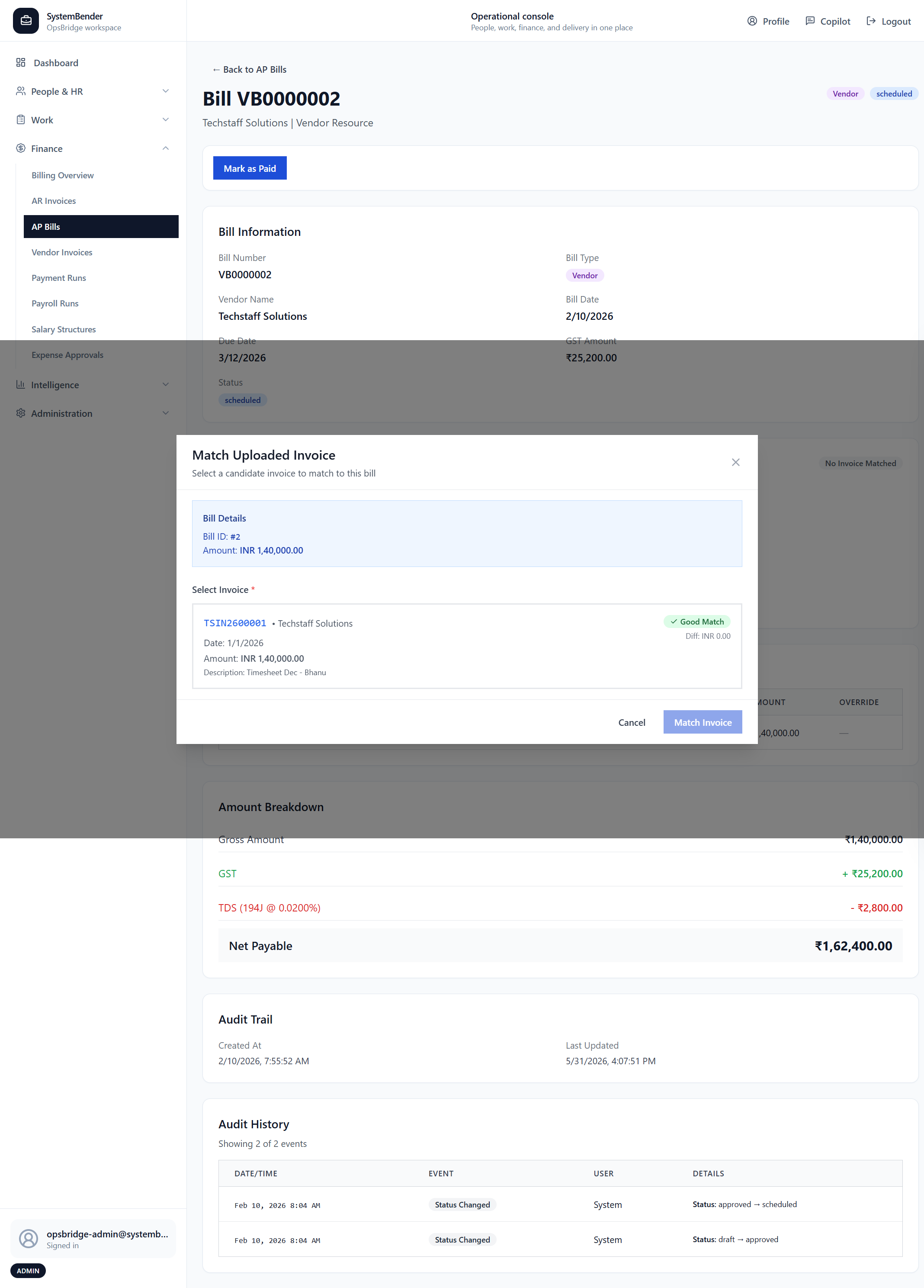
The OpsBridge matching view keeps uploaded vendor evidence beside the governed payable context, amount comparison, decision controls and audit history.
A practical control model for services businesses
A reliable workflow should make five questions answerable without reconstructing the engagement from scratch.
The vendor, person, assignment, project, entity and period are resolved to the same operating record.
The applicable working calendar, quantity, rate, currency and terms are visible from the governed baseline.
The submitted and approved time or delivery record is attached to the same chain.
Amount, quantity, reference and status variances are explicit rather than hidden inside manual comparison.
The authorised owner and available action are clear, and the decision remains in the history.
This model also improves the conversation with an external partner. Instead of asking for the whole story again, the team can point to the exact exception: a missing approval, an unmatched period, an incorrect quantity or a commercial term that needs correction.
What good matching looks like
Good matching does not mean there are never differences. Services work changes. People join part-way through a month. Calendars differ. Approvals are returned. Commercial terms are revised. Bills need correction.
The stronger test is whether the operation can recognise those differences early, route them to the right owner and preserve the evidence behind the resolution. Finance should not have to choose between speed and control, and vendors or contractors should not have to depend on fragmented status messages.
When the operating chain remains connected, invoice matching stops being detective work. It becomes a governed decision over a known obligation.
Match the obligation, not only the document.
The invoice is one piece of evidence. The dependable decision comes from connecting it to the assignment, work, terms, approval and payment context that made the obligation real.